Guide
Leaving a built-in for a month: what to do first
Leave it running, and turn the water off at the valve. Those two decisions cover most of what actually goes wrong in an empty house, and they point in the opposite direction from what people expect: the refrigeration copes with a month alone perfectly well, while the quarter inch line feeding the ice maker is the part that can cost a floor. The rest of this is a short list of things worth doing in the twenty minutes before you lock the door, and a shorter one for the first ten minutes after you get back.
Running, or empty and open. There is no third option.
Vacation mode deserves a paragraph because the phrase sets an expectation the equipment does not always meet. What that setting does varies by brand and by model, and on built-in refrigeration a panel option that looks like a vacation setting on one unit may be a Sabbath mode on another, which is a different thing entirely and lowers no load at all. Read what yours actually does in the manual for your model. On most built-in refrigeration there is nothing to switch: the useful controls are the two setpoints, the ice maker switch and the water shutoff. Leave the setpoints where they belong, which on this class of equipment is thirty-eight degrees in the fresh food compartment and zero in the freezer. Turning the cabinet colder before a trip is a common instinct and it achieves the opposite of what people hope, adding run time in a closed-up house that is already warmer than usual and freezing whatever is left against the back wall of the fresh food section.
- Take out anything perishable, and anything frozen you would not want to have to judge on your return
- Wipe up spills now: a month is long enough for something small to become the smell that greets you
- If the unit is going off rather than staying on, it has to be emptied, cleaned, dried and left standing open, or the closed cabinet grows mold in the gasket folds and around the drain
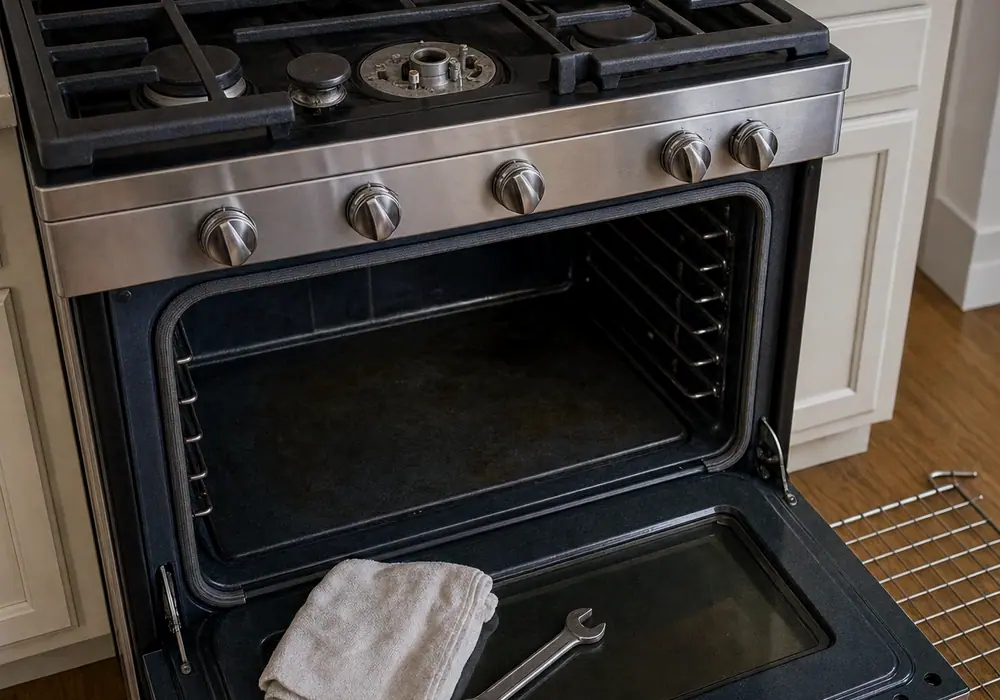
- Heavy panel doors with self-closing hinges will not stay open on their own, so block them with a rolled towel rather than trusting them
- For anything under about six weeks, leaving it running is the easier and the safer choice
The water line is the part that can cost a floor
Refrigeration failures while you are away are inconvenient. Water failures are expensive, and they are expensive precisely because nobody is there to notice for four weeks. The fittings behind a built-in are the usual suspects: a saddle valve on an older installation, a compression nut that was tightened once in 2009, or a plastic supply line with a permanent kink in it from being pushed back against the wall. A slow weep from any of those runs for a month behind cabinetry, and in a dry inland house it can evaporate off the tile almost as fast as it arrives, so what you come home to is a mineral ring and a swollen toe kick rather than a puddle. Switching the ice maker off stops the appliance asking for water. Closing the valve is what protects the house if something lets go regardless.
- Switch the ice maker off at its own control rather than just emptying the bin
- Close the shutoff that feeds the unit, usually in the adjacent cabinet, under the sink, or behind the toe kick
- While you are down there, look at the fitting itself for a green or white crust, which is a slow weep that has been drying for months
- Empty the ice bin before you go. Cubes left standing fuse into a slab over a month even in a healthy freezer, and the ejector has to fight it on your return.
- If the water filter is near the end of its life, change it after you come home rather than before, so a new one is not left sitting in stagnant water
- On return, open the valve, run several quarts through the dispenser and throw away the first two or three batches of ice
Give the condenser a fighting chance before you go
A house closed up for a month in summer sits warmer than the same house with people in it, and that room temperature is exactly what the condenser has to reject its heat into. A coil that would coast through August with someone home has less margin when the thermostat is set to a holding temperature and the blinds are open on the west side. This is the one piece of actual maintenance worth doing before a long absence rather than after, because the appliance is about to work unsupervised through the hardest weeks of its year. It takes fifteen minutes with the power off, a soft brush and a vacuum, and it is the difference between coming home to a working refrigerator and coming home to a warm one with a compressor that has been laboring since the second week.
- Clear the condenser and check that nothing has been stacked on top of the unit or pushed against the grille during the tidy-up before a trip
- Know what temperature the house thermostat will actually be holding while you are away, since that is the number the appliance has to work against
- If someone is checking the house, show them where the grille is and let them hear what a healthy condenser fan sounds like, so silence registers as wrong, and ask them to look at the floor in front of the unit each visit
Power cuts happen while you are away, and one trick tells you
You cannot prevent an outage from four hundred miles off, but you can find out whether one happened, and the answer changes what you throw away. Freeze a cup of water solid, put a coin on top of the ice and leave it in the freezer. If the coin is still on the surface when you return, the contents stayed frozen. If it has sunk to the bottom, or is sitting somewhere in the middle, the freezer thawed and refroze, and everything in there is a judgment call regardless of how solid it looks now. Worth knowing too: most modern controls hold the compressor off for a few minutes after power comes back, to let system pressures equalize before the motor tries to start against them. That is why a unit that has just been restored can look dead for several minutes and be perfectly healthy. If you switch a unit off yourself, give it the same courtesy rather than flipping it straight back on.
- The frozen cup and the coin, put in on the day you leave
- A surge device rated for a large appliance protects the control board, which is one of the parts you least want to buy, but it cannot bridge an outage
- Refrigeration survives a power cut without complaint. The food is the part that does not, and refreezing thawed food is a decision about safety rather than about the appliance.
- A flashing clock on the oven or the microwave is the usual evidence that the house lost power at some point
The first ten minutes back
Do this before the suitcases come in, because everything on the list is quicker to deal with in the first hour than in the first week. Look at the floor in front of and under the unit, and count a dry chalky ring as evidence of a leak rather than as nothing. Stand still and listen at the grille with the doors closed: the condenser fan should be running steadily, and it is the sound most people have never consciously heard until it stops. Open the doors and smell the cabinet, because a unit that lost power for a stretch will tell you before any thermometer does. Then put a thermometer in a glass of water on the middle shelf and read it an hour later rather than trusting the panel, which reports an average of a place you do not keep food. Only after that does the ice maker get switched back on.
- Floor first, including a dry mineral ring or a dark line along the toe kick
- Listen at the grille for the condenser fan before opening anything
- Glass of water and a thermometer on the middle shelf, read an hour later
- Freezer floor and bin checked for a welded slab, which is your evidence of a thaw
- Water valve back on, ice maker back on, first batches discarded
Questions
Frequently asked questions
Should I take the food out or leave it?
Take out anything perishable, along with anything frozen you would not want to have to judge on your return. Condiments, jars and frozen stock are no trouble. The reason is not the appliance, it is the power cut you never hear about: a freezer that thawed and refroze over four days while nobody was home is a cleaning job, not a repair.
Do I really need to shut the water off if I have already turned the ice maker off?
Yes. Turning the ice maker off stops the appliance asking for water; closing the valve protects the house if a line, a fitting or the inlet valve lets go anyway. That is the failure that does real damage, because nobody is there to catch it in the first hour. Ten seconds, and the most valuable item on the list.
How long can a built-in sit switched off with the doors closed?
A day is nothing; a month is a problem. A cabinet with no power and the doors shut is a sealed damp box, and the smell that develops in the gasket folds and around the drain is hard to remove. If it is going off for weeks, empty it, wipe it down, dry it and prop it open; a heavy panel door needs blocking.
Appliance down in Escondido?
Tell us the brand and what it is doing — we can usually name the likely repair before we arrive.